
Gold Leaf: Beaten Thinner Than Paper
A single gram of gold can be hammered into a sheet fine enough to see through. In Mandalay, that transformation still happens by hand, one steady rhythm of mallets at a time.

Gold is one of the most workable metals known. Struck and stretched with enough patience, it can be beaten into sheets so thin that light passes through them — thinner than paper, thinner than a human hair. In Mandalay, this transformation still happens the traditional way, by hand, inside small workshops where the sound of mallets falling in rhythm has carried on for generations.
Hours of hammering
The process starts with small pieces of gold, layered between sheets of specially treated bamboo paper and wrapped tightly in leather or parchment. These bundles are placed on a stone block, and workers take turns striking them with heavy mallets in a steady, practiced rhythm that can continue for hours.
As the gold spreads and thins under the impact, the bundle is opened, and the gold divided into smaller pieces before being wrapped again for further beating. This division and re-beating happens several times over, each round drawing the gold thinner than before, until it reaches a fineness that can only be handled with bamboo tweezers or a light puff of breath — fingers alone would tear it.
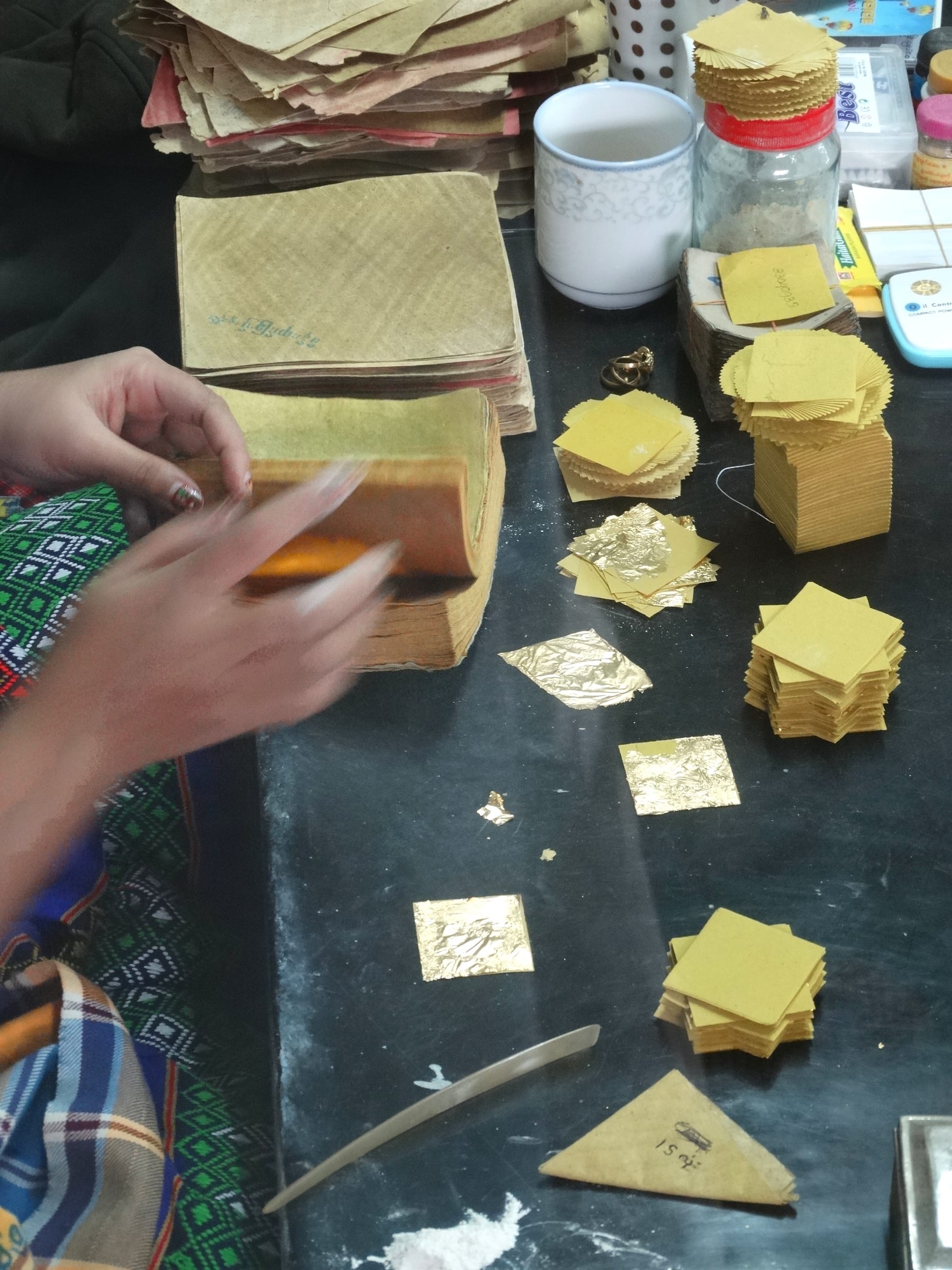
The finished sheets are trimmed into small squares and mounted on paper backing, ready to be sold in the shops that line the streets near Mandalay’s gold-beating quarter.
Gold given, layer upon layer
Much of this gold leaf finds its way to Buddhist temples across the country, where devotees press small squares onto Buddha images as an act of merit-making. Nowhere is this practice more visible than at the Mahamuni Buddha Temple in Mandalay, one of Myanmar’s most revered pilgrimage sites.

Generations of devotees have added their own small squares to the image, one on top of another, until the accumulated gold has grown thick and uneven, reshaping the statue’s surface into soft, rippling folds far removed from its original form. What began as sheets thin enough to see through has become, layer by layer, a covering inches deep — each addition a private gesture folded into a much larger, shared act of devotion.
Between the workshop and the temple, gold leaf carries a single material through two very different kinds of patience: the practiced, physical patience of the hammer, and the quieter, cumulative patience of faith.